Ethical Manifesto
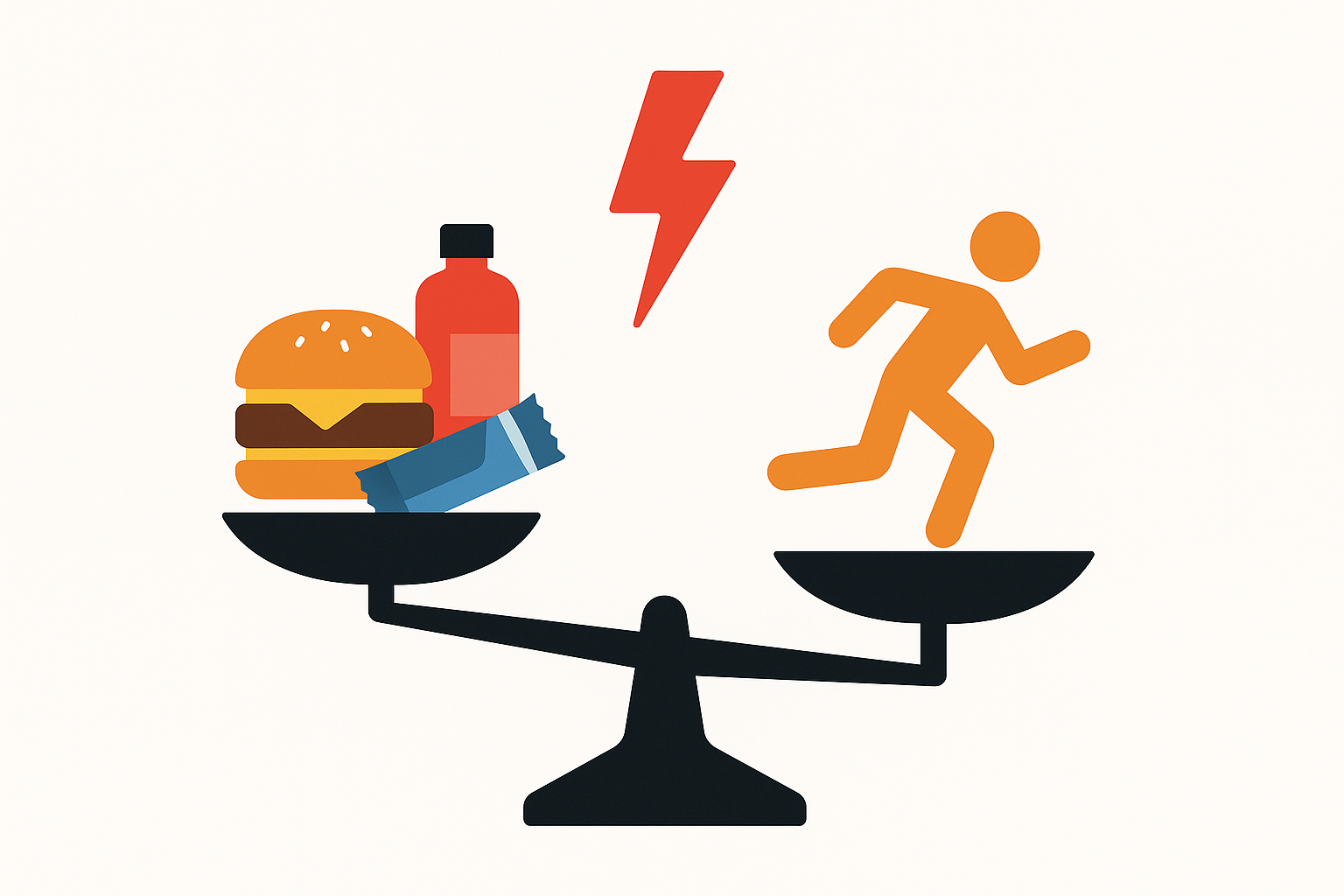
Super-intensive nutrition in sports, while not doping, creates models of
risky emulation, especially among young people.
It pushes the human body beyond natural physiology and fuels circuits of
excessive earnings for athletes and teams, drifting away from the original meaning of sport.
A collective ethical reflection is needed: do we want a sport of
education and health or a machine that burns bodies and resources?
Method AlBar & AI – August 2025
Introduction
In professional sports, nutrition is an integral part of athletic preparation. Athletes across disciplines grow within programs that supply large amounts of tailored energy. This approach—often called “super-intensive nutrition”—raises ethical questions: where is the line between legitimate preparation and the edge of doping?
Super-intensive sports nutrition
- Caloric intake: endurance sports up to ~8,000 kcal/day; field & racquet sports up to ~4,500 kcal/day.
- Indicative split: 55–65% carbohydrates, 15–20% protein, 20–25% fat.
- Timing: pre-event fueling; in-event (gels, bars, drinks); post-event recovery.
- Goal: maximize the body’s capacity to oxidize carbs and fats under prolonged stress.
Examples across disciplines
- Endurance athletics (marathon, 10,000 m, ultratrail): 5,000–7,000 kcal/day; careful glycogen management.
- Competitive swimming: up to ~6,000 kcal/day with immediate post-workout replenishment.
- Cross-country skiing: among the most energy-demanding, 7,000–8,500 kcal/day during races.
- Triathlon / Ironman: minute-by-minute fueling plans with liquid and solid intake during the event.
- Rowing & kayak: up to ~6,000 kcal/day, balancing endurance and muscle mass.
- Team sports (soccer, basketball, rugby): 3,500–5,000 kcal/day with strong focus on timing and hydration.
- Power-explosive sports (weightlifting, sprinting, gymnastics): fewer total calories but targeted nutrition for strength and recovery (e.g., protein/creatine).
Gray zone: the so-called “nutritional doping”
Without breaking rules, many athletes use extreme nutritional strategies or supra-physiological doses of legal supplements (caffeine, bicarbonate, beta-alanine, ketone esters). These practices, while permitted, push metabolism beyond natural limits and raise ethical and cultural concerns—also due to emulation effects.
True doping
By WADA definition, doping involves prohibited substances or methods (e.g., EPO, anabolic steroids, blood transfusions) that artificially alter performance. Beyond violating fairness, it carries significant health risks and leads to sporting and legal sanctions.
Level comparison
| Level | Practice | Status | Example | Risk |
|---|---|---|---|---|
| Legitimate nutrition | Balanced high-calorie meals, basic supplements | Permitted | Structured nutrition programs | Moderate, sustainable |
| Gray zone | Massive supplements, extreme strategies | Permitted but controversial | Ketone esters, high-dose caffeine | Medium–high, metabolic stress |
| Doping | Prohibited substances and methods | Forbidden | EPO, steroids, transfusions | Very high, dangerous |
Conclusion
Super-intensive nutrition is not doping, yet it is a metabolic exacerbation that pushes the body beyond common physiology. It is legal under current rules but remains ethically debatable when it becomes a prerequisite for elite success—especially when it drives emulation and concentrates economic power among a few actors.
Essential references
- World Anti-Doping Agency (WADA). Prohibited List 2025. Montréal: WADA, 2025.
- IOC Consensus Statement on Sports Nutrition. Journal of Sports Sciences, 2018; 36(sup1): 7–17.
- Burke LM, Hawley JA. Swifter, higher, stronger: What’s on the menu? Science, 2018; 362(6416): 781–787.
- Jeukendrup AE. Nutrition for endurance sports. J Sports Sci, 2011; 29(sup1): S91–S99.
- Maughan RJ, Shirreffs SM. Nutrition and hydration concerns in elite racquet sports. Br J Sports Med, 2008; 42(10): 89–95.
- Spriet LL. Exercise and sport performance with low doses of caffeine. Sports Med, 2014; 44(Suppl 2): S175–S184.
- Pitsiladis YP et al. Beyond doping: Nutrition and elite endurance performance. Int J Sport Nutr Exerc Metab, 2019; 29(2): 111–123.
Note: Calorie ranges are indicative and vary by age, sex, body mass, climate, and season phase.
 A little science for everyone
Leave a comment