Free Report Extract
Executive summary
Causing an estimated one in every nine deaths worldwide, air pollution is the greatest environ-mental threat to human health. According to the World Health Organisation (WHO), air pollution’s responsible for an estimated seven million premature deaths worldwide every year.
Exposure to PM2.5 air pollution leads to and exacerbates numerous health conditions, including but not limited to asthma, cancer, stroke, and lung disease. Additionally, exposure to elevated levels of fine particles can impair cognitive development in children, lead to mental health issues, and complicate existing illnesses including diabetes.
The data utilised to create this report was aggregated from the global distribution of more than 30,000 regulatory air quality monitoring stations and low-cost air quality sensors operated by research institutions, governmental bodies, universities and educational facilities, non-profit non-governmental organisations, private companies, and citizen scientists.
The 2022 World Air Quality Report included data from 7,323 locations in 131 countries, regions, and territories. In 2023, those numbers have grown to include 7,812 locations in 134 countries, regions, and territories. Coverage in Africa has expanded significantly in 2023 with seven new countries being added to the region. Coverage has also expanded across Latin America with four additional countries included in 2023. The African nations of Chad and Sudan, as well as the West Asian country of Iran, are notably absent in 2023 due to a lack of publicly available
monitoring data.
In 2023, 10 out of the reporting 134 countries and regions succeeded in achieving the WHO annual PM2.5 guideline value of 5 μg/m 3 . With only 9% of globally reporting cities achieving the WHO annual PM2.5 guideline, much more work remains to be done to combat air pollution.
While PM2.5 poses direct health risks, its implications extend beyond human health to complex environmental processes impacted by the Earth’s climate. Climate change, primarily driven by greenhouse gas emissions, plays a pivotal role in influencing concentrations of PM2.5 air pollutants, and fossil fuel emissions are simultaneously responsible for the majority of PM2.5 related deaths. Simultaneously addressing air pollution and climate change goals is feasible, offering opportunities for comprehensive environmental improvements.
Why PM2.5?
PM2.5 concentration, fine particulate aerosol particles measuring up to 2.5 microns in diameter, is the primary air quality indicator for the World Air Quality Report. Measured in micrograms per cubic meter (μg/m³), PM2.5 is one of six common pollutants monitored and regulated by environmental agencies worldwide due to the significant impacts to human health and the environment.
PM2.5 can originate from a variety of sources, each potentially resulting in distinct chemical compositions and physical characteristics. Common components of PM2.5 include sulphates, black carbon, nitrates, and ammonium. Anthropogenic sources of PM2.5 are predominantly linked to combustion engines, industrial processes, power generation, coal and wood burning, agricultural activities, and
construction. Natural sources include dust storms, wildfires, and sandstorms.

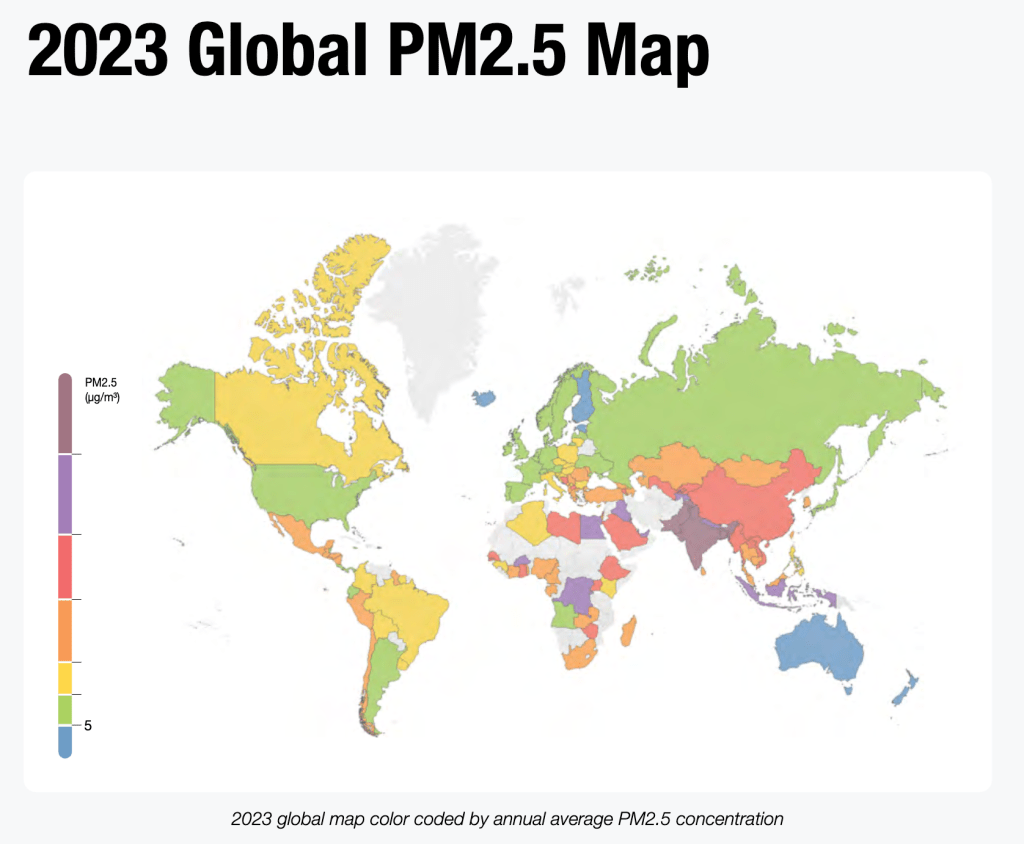
Extrapolating the data, the geographical areas with the lowest concentrations of PM2.5 are the United States of America, Europe, Scandinavia, some Eastern European countries and the Russian territory. To be more precise, the individual geographical areas must be examined.
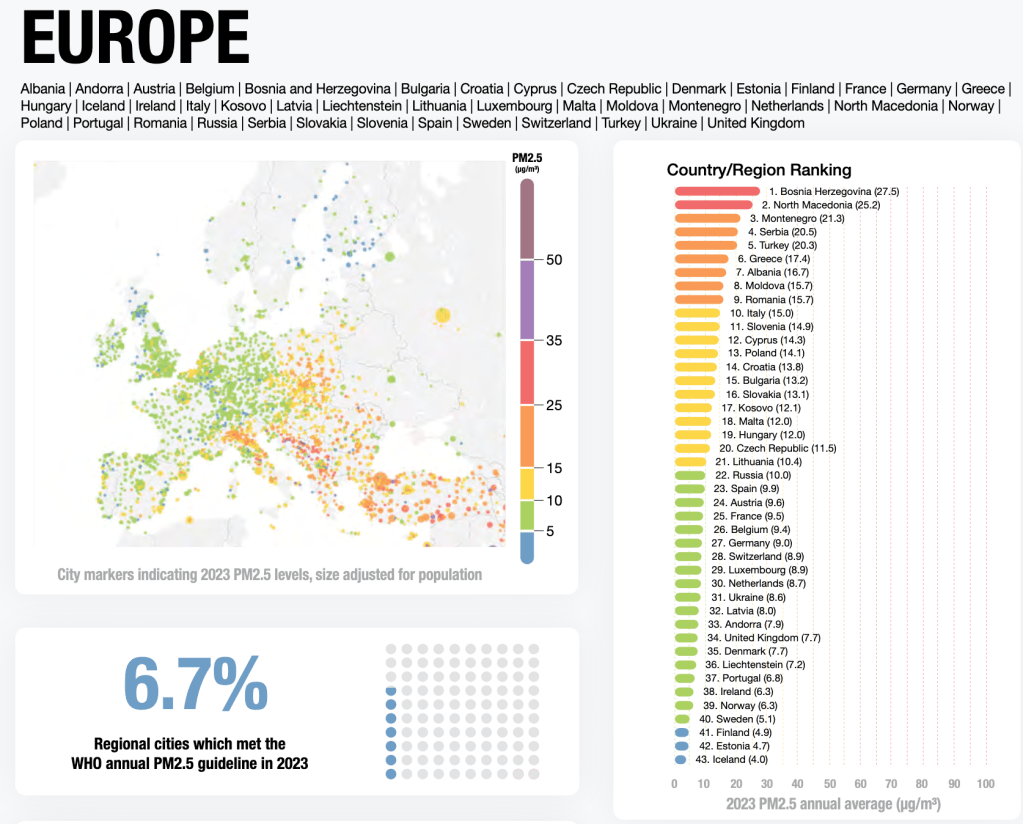
Much of Europe has low PM2.5 values and only 6.7% of the measures exceed the WHO guideline value in 2023. Italy (especially the Po Valley), the Balkan countries, Turkey and large areas of the countries of the east show higher values than the targets.
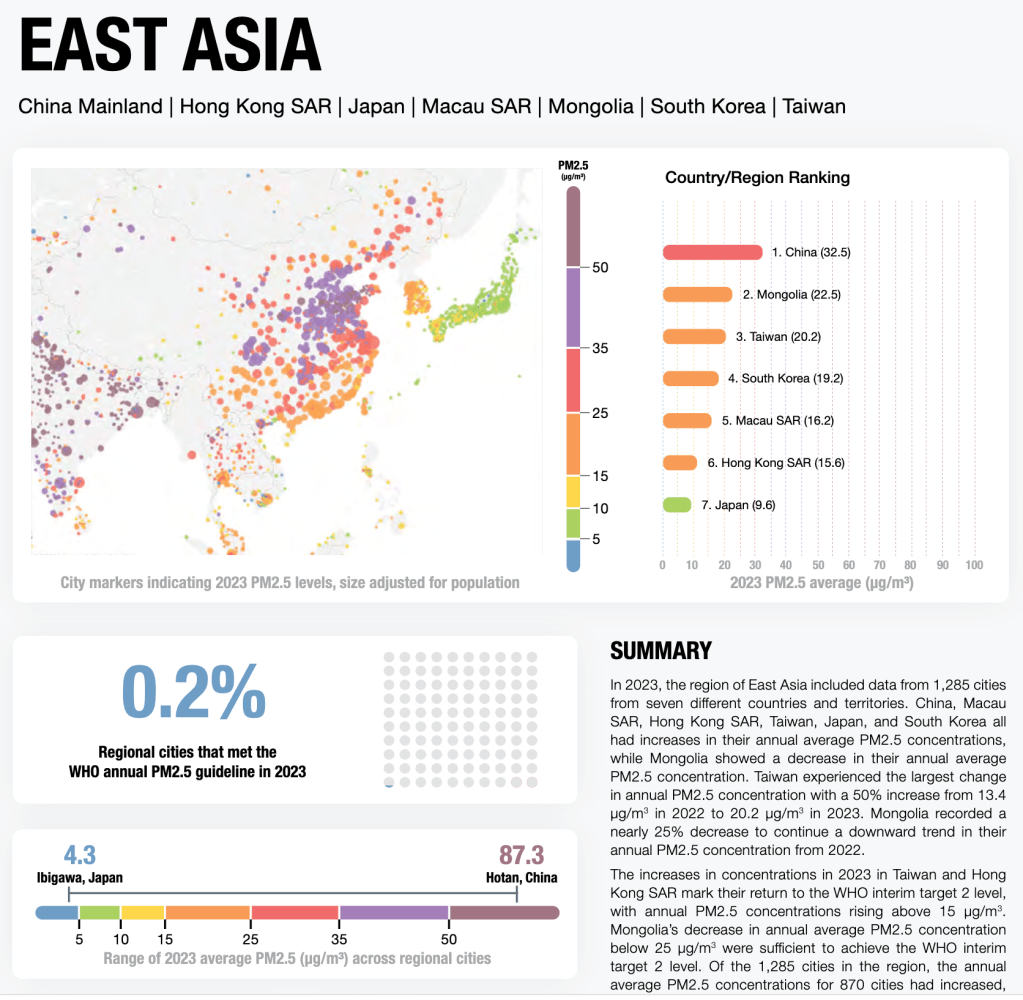
In East Asia, WHO’s leading concentrations are practically exceeded by a factor of between 4 and 20 times and this particularly in China and India.

In North America only 14% of the sites measured show an exceeding of the WHO guide values, especially in Mexico, some areas in Canada, and me Middle West of the United States of America.
To download the original and complete Report:
Happy reading
 A little science for everyone
Leave a comment