
Organic molecules consist of one or more carbon atoms (C) bonded with other atoms of C and/or atoms of oxygen (O), nitrogen (N), sulfur (S), phosphorus (P) and others. Multiatomic molecules can occur in the form of an open or closed chain(s). The simplest molecules (H2, H2O, CH4, NH3, CO, H2S, … ) interact with each other even at temperatures close to absolute zero (0 Kelvin = -273.15 °C), under the action of ultraviolet (UV) rays and electromagnetic radiation emitted by stars during their existence. To date, more than 256 molecular species have been identified in interstellar clouds and circumstellar shells. They include aldehydes, alcohols, acids, amines and carboxamides, i.e. the main functional groups needed to initiate the formation of prebiotic molecules and RNAs. It is worth noting that no amino acids have been found to date in interstellar space, despite multiple searches. However, precursors of some glycine amino acids have been found, such as: methylamine, formaldehyde, gliconitrile and aminoacetonitrile. In addition, cyanomethanimine (a dimer of HCN) was found to be a possible precursor to adenine, one of the four nucleobases of DNA. For further information, visit the articles on the FRONTIERS website at the following address: https://www.frontiersin.org/articles/10.3389/fspas.2022.787567/full
For example, a double-cycle hydrocarbon molecule, detected in space, is indene (Cernicharo et al., 2021d)
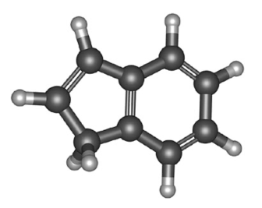
Fairly complex linear or cyclic chain organic compounds, consisting of six or more C atoms are gasoline (c-C6H4), indene (c-C9H8) and cyanoethyleneneallene (H2C2CHC3N) which were discovered in 2022 along with a number of new hydrocarbons and/or cyanohydrocarbons. The James Webb Space Telescope has detected the presence of polycyclic aromatic hydrocarbons (PAHs) at a distance of about 12 billion light-years. These are substances (PAHs) composed of two or more aromatic rings (benzenes) linked to each other on one or more sides. Polycyclic aromatic hydrocarbons (PAHs) are large organic molecules that track millimeter-sized dust grains and regulate the cooling of interstellar gas within galaxies. A simple example is nut from naphthene:

As research continues, the number of known species will grow exponentially and from the current 256 values will be reached even larger. We may begin to think that the molecules needed to build amino acids, proteins, sugars, fats, etc., were formed in space and are present, albeit in very low concentrations, throughout the universe. These molecules are also likely distributed throughout space and may recombine into other, larger, yet-to-be-discovered molecules. They can be transported into space and fall by gravity onto planets and galactic amass. Depending on the environmental conditions of the planets where they fall, they will be able to react further with each other to produce long organic chains capable of copying, reproducing and protecting themselves from adverse conditions. In addition, they will be able to evolve into increasingly energetically stable structures containing the codes necessary for their survival and reproduction.
Other links:
 A little science for everyone
Leave a comment