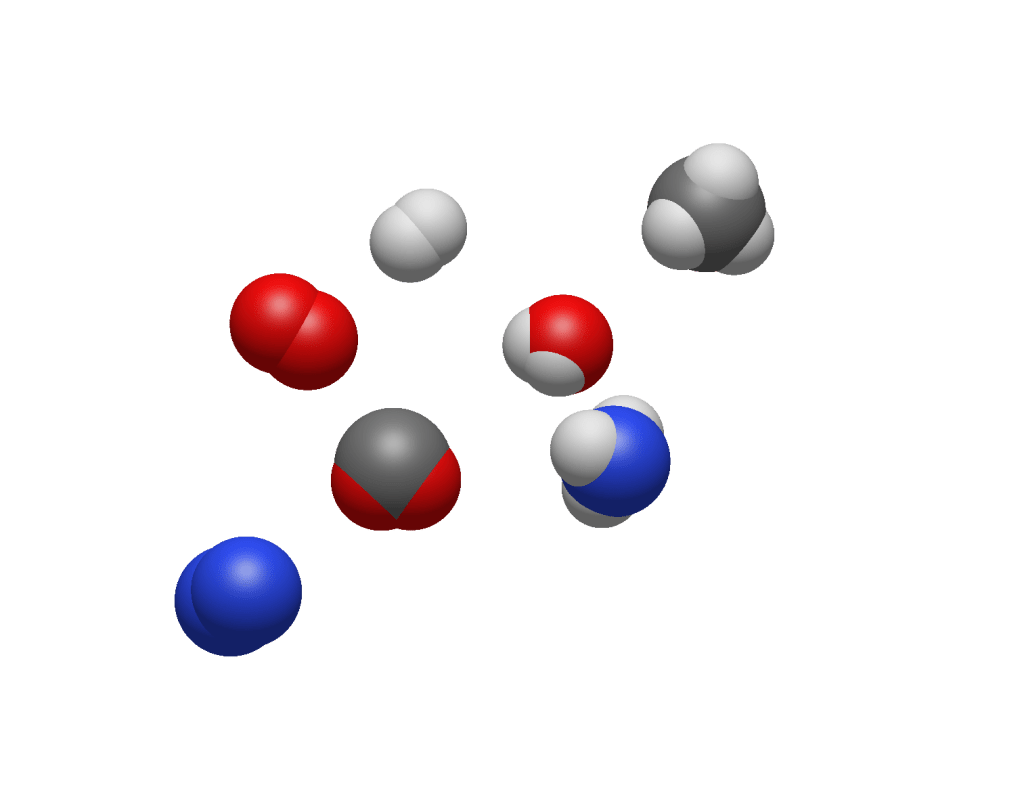

The molecule is the smallest particle of physically stable matter thanks to which the mineral, plant and animal world was born and evolved. The smallest molecule is hydrogen, which is made up of two hydrogen atoms that bind stably to each other (H2). It is also the most important because, thanks to it, the sun and all the other stars burn up transforming hydrogen into helium (He), releasing enormous amounts of energy through radiation and particles that propagate in the distances of cosmic space. Considering, however, the enormous size of the universe, the concentration of hydrogen is infinitesimal in the universe. Even in the Earth’s atmosphere, the hydrogen molecule is very rare: about 1 part per million (1 ppm). Stars, depending on their mass, the duration of their existence, and the manner of their demise, also produce other, heavier atoms. They are projected into the universe by combining with each other to provide molecules such as: methane (CH4), ammonia (NH3), water (H2O) and carbon dioxide (CO2). These simple molecules recombine and produce more tablets that are at the origin of life on our planet as well. The reactivity of the first simple molecules is regulated by the stellar emission of electromagnetic discharges (⚡such as lightning ⚡) and high-frequency radiation (ultraviolet UV ray): the small molecules find more stability by transforming and binding together into larger molecules that require more energy to change.
 A little science for everyone
Leave a comment